You buy good coffee.
Open the bag.
It smells incredible.
You grind the beans.
Start brewing.
The kitchen fills with exactly the aroma you were hoping for.
Then you take the first sip.
And—
sour.
Not pleasantly bright.
Not fruity.
Not refreshing.
Just sharp.
Thin.
Almost aggressively acidic.
So naturally, you blame the beans.
Maybe the coffee is bad.
Maybe the roast is weird.
Maybe the café sold you something you simply do not like.
That’s possible.
But before replacing the entire bag, it is worth understanding why your coffee tastes sour, because the beans themselves may not be the problem.
Sometimes the problem is extraction.
And a surprisingly small change to the way you brew can completely change the cup.
First: Sour Coffee and Acidic Coffee Are Not Necessarily the Same Thing
This distinction matters.
Coffee naturally contains acids and can have noticeable acidity as part of its flavor profile.
That is not automatically a defect.
A well-brewed coffee might remind you of:
citrus,
berries,
stone fruit,
apple,
grape,
or other bright flavors.
That brightness can be intentional and enjoyable.
Sourness Feels Different
When people complain that coffee tastes sour, they often mean something sharper and less balanced.
The cup may feel:
thin,
hollow,
sharp,
unfinished,
or unpleasantly tart.
Instead of acidity being one part of the flavor, it dominates everything else.
Think of the Difference Between Fruit and Lemon Juice
A ripe orange has acidity.
But it also has sweetness and other flavors balancing it.
Straight lemon juice is much more aggressively sour.
Coffee can behave similarly.
Balance Matters More Than Acidity Alone
So before trying to “remove acidity,” figure out whether you actually dislike acidic coffee or whether your brew is simply unbalanced.
One of the Most Common Causes: Under-Extraction
When water contacts ground coffee, it dissolves compounds from the grounds.
This process is called extraction.
You are essentially using water to pull flavor from coffee.
But Extraction Does Not Happen All at Once
Different compounds become available throughout the brewing process.
If the brewing conditions do not extract enough from the coffee, the resulting cup can taste underdeveloped.
Sourness is one of the common sensory signs associated with under-extraction.
In Simple Terms
Water did not pull enough from the grounds.
The brew stopped too early—or extraction happened too inefficiently.
The result can taste sharp and incomplete.
Coffee Extraction Is a Balancing Act
Imagine three broad possibilities.
Too little extraction: the coffee may taste sour, thin, or weak.
Balanced extraction: sweetness, acidity, bitterness, aroma, and body work together.
Too much extraction: harsh bitterness, dryness, or astringency may become more noticeable.
This is simplified, but extremely useful for troubleshooting at home.
The Goal Is Not Maximum Extraction
You do not want to extract absolutely everything possible.
You want a balanced cup.
Grind Size Can Completely Change the Taste
Suppose your coffee tastes sour.
One of the first things worth checking is your grind.
Coarse Grounds Have Less Accessible Surface Area
Water may move around or through them more easily depending on the brewing method.
If the grind is too coarse for your recipe, extraction may be insufficient.
The Result?
Potentially:
sourness,
weakness,
thin body,
and an unfinished flavor.
Try Grinding Slightly Finer
Not dramatically finer.
Slightly.
Then brew again.
Taste.
Coffee Troubleshooting Works Best With Small Adjustments
If you change five variables simultaneously, you will not know which change actually helped.
Grind Size Is Not Universal
There is no single “correct” coffee grind.
It depends on your brewing method.
Espresso generally requires a much finer grind than French press.
Pour-over occupies another range.
AeroPress recipes can vary considerably.
This Is Why Pre-Ground Coffee Can Be Limiting
A grind selected for one brewing method may not perform ideally in another.
Your Brewer Determines the Context
Do not ask:
“Is this grind good?”
Ask:
“Is this grind appropriate for this brewing method and recipe?”
Much better question.
Brewing Time Matters Too
Extraction needs contact between water and coffee.
If that contact ends too quickly, the water may not extract enough soluble material.
A Very Fast Brew Can Be a Clue
Suppose your pour-over recipe normally takes several minutes.
Today the water races through much faster.
Then the coffee tastes noticeably sour.
Those two observations may be related.
Why Did It Run Fast?
Possibly because:
the grind was too coarse,
the pouring technique changed,
the coffee dose changed,
or the brewing conditions changed in another way.
Brew Time Is Useful Information
But do not treat it as the only target.
A coffee that finishes at exactly 3:00 is not automatically delicious because a stopwatch approved it.
Taste remains important.
Water Temperature Can Affect Extraction
Hotter water generally extracts soluble compounds more effectively than cooler water under otherwise similar conditions.
If Your Brewing Water Is Too Cool
Extraction can become less efficient.
That may contribute to a sour or weak cup.
A Common Home-Brewing Problem Is Waiting Too Long
You boil water.
Then:
answer a message,
find the filter,
rinse something,
search for your mug,
feed the cat,
and remember the coffee seven minutes later.
The water has cooled considerably.
Then You Brew
And wonder why today’s cup tastes different.
Consistency matters.
But Do You Need Exactly 93°C?
Not necessarily.
Coffee brewing advice sometimes becomes unnecessarily obsessed with one magical number.
There is no single water temperature that is perfect for:
every coffee,
every roast,
every brewing method,
and every preference.
Temperature Is a Variable
Use it intentionally.
If your coffee is persistently under-extracted and sour, hotter brewing water may be one adjustment worth testing.
Roast Level Changes the Equation
A light-roasted coffee and a dark-roasted coffee can behave very differently.
Light roasts generally preserve more of the bean’s original character and can be more challenging to extract.
They May Also Taste Naturally Brighter
That is important.
You could brew a light Ethiopian coffee perfectly and still experience noticeable fruit-like acidity.
That does not mean something went wrong.
Darker Roasts Tend to Present Different Flavors
Often more associated with:
chocolate,
caramelized flavors,
roast character,
and bitterness.
This is a broad generalization—coffee is much more complex—but it is useful when choosing beans.
Maybe You Simply Don’t Like Bright Coffee
And that’s completely fine.
Coffee culture sometimes creates the impression that you are supposed to appreciate every flavor profile.
You are not.
Taste Is Personal
If you consistently dislike coffees described as:
bright,
citrusy,
floral,
juicy,
or fruit-forward,
you may simply prefer another style.
Try coffees described with notes such as:
chocolate,
nuts,
caramel,
brown sugar,
or cocoa.
Brewing Cannot Turn Every Bean Into Every Flavor
Technique matters.
But the coffee itself still sets boundaries.
Origin Can Influence Flavor Expectations
Coffee from different regions, farms, varieties, processing methods, and growing conditions can produce dramatically different sensory profiles.
Country Alone Does Not Determine Taste
Do not assume:
“Coffee from Country X always tastes like this.”
That is far too simplistic.
But origin can provide clues when combined with:
variety,
processing,
elevation,
roast,
and producer information.
The Bag Can Tell You Something
Read it.
Processing Method Can Affect Perceived Acidity and Sweetness
Coffee processing broadly refers to how the fruit and seed are handled after harvest.
You may see terms such as:
washed,
natural,
honey,
anaerobic,
or other processing descriptions.
These Can Influence Flavor
A washed coffee may present clarity and brightness differently from a natural-processed coffee with more fruit-forward characteristics.
Again, these are tendencies, not rigid laws.
Two Coffees Can Break Every Expectation
That is part of what makes coffee interesting.
Freshness Can Change the Cup Too
Coffee does not remain chemically identical forever after roasting.
As roasted beans age, volatile aroma compounds change and carbon dioxide escapes.
But “Freshest Possible” Is Not Always “Best Possible”
Coffee can benefit from some resting time after roasting, particularly depending on roast style and brewing method.
Espresso Can Be Especially Sensitive
Very fresh coffee may behave differently during extraction because of retained gases.
The Important Lesson Is Consistency
If the same coffee tastes dramatically different across days, freshness may be one variable among several.
Your Coffee-to-Water Ratio Matters
Suppose you use:
15 grams of coffee one day.
22 grams the next.
Same water.
Same grind.
Same brewer.
Those cups are not equivalent.
Coffee Strength and Extraction Are Related but Different
This distinction confuses many beginners.
A cup can be:
strong but under-extracted,
weak but over-extracted,
or anywhere between.
“Strong” Does Not Simply Mean “Bitter”
And “weak” does not simply mean “sour.”
Strength describes concentration.
Extraction describes how much soluble material was removed from the coffee.
Keeping Your Ratio Consistent Makes Troubleshooting Easier
A scale helps.
Do You Actually Need a Coffee Scale?
No.
Human civilization survived before affordable digital coffee scales.
You can make enjoyable coffee without one.
But a Scale Makes Repetition Easier
Instead of:
“some beans and about this much water,”
you can repeat:
15 grams coffee.
250 grams water.
Then adjust deliberately.
Consistency Turns Guessing Into Experimenting
That is the real advantage.
Water Quality Is an Invisible Variable
Your finished cup is mostly water.
So naturally, the water matters.
Extremely Different Mineral Composition Can Change Extraction and Flavor
Water that is unsuitable for brewing can make excellent coffee harder to achieve.
But Do Not Immediately Buy Laboratory Equipment
Start with the obvious variables first:
fresh coffee,
appropriate grind,
reasonable ratio,
suitable water temperature,
and consistent technique.
Then investigate water if problems remain.
Why Does Pour-Over Coffee Sometimes Taste Sour?
Pour-over brewing gives you considerable control.
Which also means you have considerable opportunity to accidentally change things.
Sour Pour-Over Can Come From
grinding too coarse,
brewing too quickly,
using insufficiently hot water,
uneven extraction,
or choosing a naturally bright coffee you simply do not prefer.
Uneven Extraction Is Particularly Important
If some coffee grounds receive much more water contact than others, the bed may not extract evenly.
What Is Channeling?
Channeling happens when water finds easier paths through the coffee instead of flowing evenly through the entire bed.
Water Likes the Easy Route
If one area provides less resistance, more water may flow there.
Other areas receive less effective extraction.
The Cup Becomes a Mixture
Some coffee may be under-extracted.
Other portions may be extracted differently.
This Can Create Confusing Flavors
Sourness and bitterness can sometimes appear together.
Which leads to an important point.
Coffee Can Taste Sour and Bitter at the Same Time
People often imagine a simple line:
SOUR ← PERFECT → BITTER
Real brewing is messier.
Uneven Extraction Can Produce Multiple Unpleasant Flavors
One part of the coffee bed may extract differently from another.
So you may taste:
sharp acidity,
bitterness,
dryness,
and thinness
in the same cup.
That Is Why “Just Brew Longer” Does Not Solve Everything
You also need even extraction.
Espresso Makes Sourness Very Obvious
Pull an espresso shot too quickly and you may get a tiny cup of concentrated disappointment.
Sour Espresso Often Suggests Insufficient Extraction
Potential adjustments can include:
grinding finer,
increasing extraction time,
adjusting yield,
or changing temperature.
But espresso variables interact strongly.
Change One Thing at a Time
This rule becomes especially important with espresso.
Otherwise you will spend 45 minutes turning every dial on the machine and somehow make the coffee worse.
Why Does My Espresso Shot Run Too Fast?
If water flows through the puck with too little resistance, grind size may be too coarse.
Other factors can include:
dose,
distribution,
puck preparation,
and the coffee itself.
Fast Flow Plus Sour Taste Is Useful Evidence
Try a finer grind.
Then compare.
Do Not Chase Someone Else’s Exact Shot Time Blindly
Their:
machine,
grinder,
basket,
coffee,
roast date,
dose,
and water
may differ from yours.
Use recipes as starting points.
French Press Can Taste Sour Too
French press uses immersion brewing.
The coffee grounds remain in contact with water rather than water continuously passing through a bed.
If French Press Tastes Sour
Possible variables include:
grind,
water temperature,
brewing time,
ratio,
and bean selection.
Do Not Automatically Use Extremely Coarse Grounds
The old advice that French press always requires huge gravel-like coffee particles can sometimes lead home brewers toward weak extraction.
Experiment.
AeroPress Is Extremely Flexible
This is both its greatest strength and its greatest danger.
People use:
different grind sizes,
different temperatures,
different brew times,
different ratios,
standard methods,
inverted methods,
and countless recipes.
There Is No Single AeroPress Flavor
If your cup is sour, think about extraction.
Could you:
grind finer?
use hotter water?
extend contact time?
adjust agitation?
Test One variable
Taste again.
Cold Brew Is Different
Cold brew uses low-temperature water and compensates with much longer contact time.
You Cannot Apply Every Hot-Brewing Rule Directly
A 12-hour cold brew is obviously not “brewing too long” simply because a pour-over takes minutes.
Brewing Method Changes the Context
Always troubleshoot within the method you are actually using.
What About Instant Coffee?
If instant coffee tastes sour, you have far less control over extraction because the coffee was already brewed before being dehydrated into soluble form.
Your Main Variables Are Different
concentration,
water temperature,
water quality,
milk,
and other additions.
If You Consistently Dislike the Flavor
Try another product.
There is no grinder adjustment available to rescue instant coffee.
Milk Can Hide or Highlight Acidity
Adding milk changes the sensory experience significantly.
Its:
fat,
protein,
sweetness,
and texture
interact with coffee flavor.
Some Bright Coffees Work Beautifully Black
But may taste strange to someone expecting a chocolate-heavy milk drink.
Bean Selection Should Match the Drink
If your morning routine is always:
coffee + lots of milk,
choose beans that taste good in that context.
There is no prize for using the most exotic light roast.
Sugar Can Cover Sourness Without Fixing It
Add enough sugar and almost anything becomes easier to drink.
But if your goal is improving your brewing technique, sweetener can hide useful information.
Taste the Coffee Before Adding Anything
At least while troubleshooting.
Then add milk or sugar however you actually enjoy drinking it.
Coffee Is Supposed to Be Enjoyed
Not passed like an exam.
The Easiest Way to Fix Sour Coffee
Do not rebuild your entire brewing setup.
Start simple.
If your coffee tastes noticeably sour and you suspect under-extraction:
First, grind slightly finer.
Keep everything else the same.
Brew again.
Taste.
Still Sour?
Try increasing extraction through another controlled adjustment.
Depending on the brewing method, that could mean:
slightly longer contact time,
hotter water,
or improved technique.
One Change at a Time
This cannot be repeated enough.
Keep a Tiny Brewing Log
You do not need a leather notebook titled:
THE SCIENCE OF MY MORNING COFFEE.
Your phone is enough.
Write:
Coffee: Ethiopia washed
Dose: 15 g
Water: 250 g
Grind: setting 18
Water: just off boil
Time: 2:45
Taste: sour, thin
Next attempt:
Grind: 16
Everything else: same
Taste: sweeter, fuller
Congratulations
You are now troubleshooting instead of guessing.
Taste Is More Useful Than Internet Rules
Coffee recipes are valuable.
But your mouth gets the final vote.
Suppose the Internet Says
“Brew this coffee at exactly 92°C.”
You prefer it at 96°C.
Drink the one you prefer.
The Recipe Does Not Have Feelings
You are allowed to disagree with it.
Sourness Can Become More Noticeable as Coffee Cools
Temperature affects perception.
A coffee may taste very different:
extremely hot,
warm,
and near room temperature.
This Is Why Coffee Professionals Often Taste Across Temperatures
As the cup cools, different characteristics become easier to notice.
Do Not Judge the Entire Brew From One Burning-Hot Sip
Give it a few minutes.
Taste again.
Sometimes the Coffee Is Actually Supposed to Taste Like That
This is perhaps the most frustrating answer.
You changed:
grind,
temperature,
time,
ratio,
technique.
The coffee still tastes bright.
Maybe That’s the Coffee
Read the tasting notes.
If the bag says:
lemon,
green apple,
cranberry,
and grapefruit,
while you want:
dark chocolate,
caramel,
and roasted nuts,
you may simply have purchased the wrong flavor profile for your preference.
That Is Not a Brewing Failure
It is useful information.
Learn Your Own Coffee Preferences
You do not need to memorize every coffee-growing region.
Start recording what you like.
Maybe You Discover
medium roasts.
chocolate-forward coffees.
natural processing.
low perceived acidity.
heavy body.
Great
Now buying coffee becomes easier.
Or maybe you discover the opposite:
light roasts.
floral aromas.
high clarity.
bright fruit.
Also great
There is no correct personality type for coffee.
Sour vs. Bitter Coffee: A Simple Comparison
If you are still learning to identify the difference, think about familiar foods.
Sourness
Think:
lemon,
vinegar,
unripe fruit,
sour candy.
It often creates a sharp, mouth-puckering impression.
Bitterness
Think:
unsweetened cocoa,
tonic water,
certain dark leafy greens,
burnt toast.
Different sensation.
Coffee Can Contain Both
And your ability to distinguish them improves with attention.
Do a Simple Taste Experiment
Make two small brews using the same coffee.
Brew A
Intentionally make extraction lower—for example, slightly coarser within a sensible range.
Brew B
Use a somewhat finer grind.
Keep other variables as consistent as possible.
Taste Them Side by Side
Not because one recipe will universally be correct.
But because contrast teaches your palate.
Comparative Tasting Is Powerful
It is easier to understand “more sour” when another cup is sitting beside it.
Don’t Change Beans Every Time a Cup Goes Wrong
This is one of the biggest beginner mistakes.
Cup tastes bad.
Buy another coffee.
Still bad.
Buy another.
If Your Technique Is the Problem
You are simply purchasing more opportunities to repeat it.
Learn One Coffee First
Use the same beans for several brews.
Adjust.
Taste.
Repeat.
Once you understand how that coffee responds, experimentation becomes easier.
But Don’t Spend an Entire Bag Fighting a Coffee You Hate
There is a limit.
If the coffee’s natural flavor profile simply does not match your preference, move on.
Brewing Is Not a Moral Commitment
You are allowed to dislike beans.
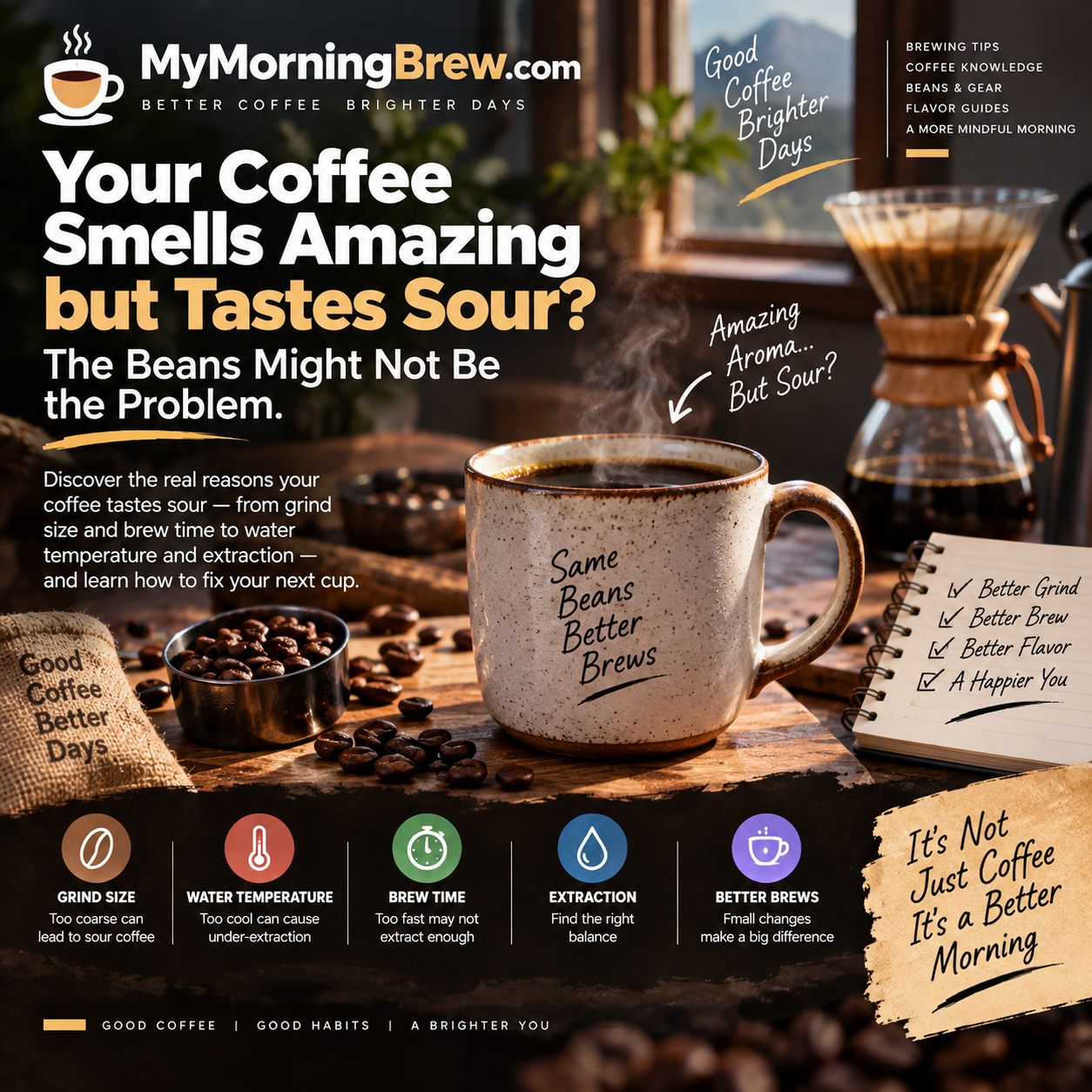
A Simple Sour Coffee Troubleshooting Order
When your coffee tastes unexpectedly sour, check these five things:
1. The beans
Is the coffee naturally bright or fruit-forward?
2. Grind size
Could your grind be too coarse for the method?
3. Brewing time
Is water moving through unusually quickly, or is contact time too short?
4. Water temperature
Could your brewing water be too cool?
5. Evenness
Is water contacting the coffee consistently, or could channeling/uneven extraction be happening?
Then Adjust One Variable
Brew.
Taste.
Repeat.
That process teaches you far more than endlessly searching:
“perfect coffee recipe.”
The Goal Isn’t to Remove Every Acid
A completely flat coffee is not necessarily a better coffee.
Acidity can provide:
brightness,
complexity,
structure,
and freshness.
You Want Balance
A good cup can be bright without tasting aggressively sour.
Sweet without containing sugar.
Bitter without being harsh.
Complex without being confusing.
That Balance Is What You Are Chasing
Not a cup with zero acidity.
FAQ
Why does my coffee taste sour?
Sour coffee can be associated with under-extraction, meaning the brewing process did not extract enough soluble material from the grounds. Grind size, brewing time, water temperature, technique, and the coffee’s natural flavor profile can all influence the result.
How do I fix sour coffee?
A useful first experiment is grinding slightly finer while keeping your other brewing variables consistent. Depending on your brewing method, increasing contact time or using hotter water may also increase extraction.
Does sour coffee mean the beans are bad?
No. Some coffees naturally have bright, fruit-like acidity. An unpleasantly sour cup can result from brewing, but it may also mean the coffee’s flavor profile does not match your preferences.
Is sour coffee under-extracted or over-extracted?
Sourness is commonly associated with under-extraction, although real coffee extraction can be uneven and more complicated than a simple sour-versus-bitter rule.
Why does my pour-over taste sour?
Possible causes include a grind that is too coarse, a brew that runs too quickly, water that is too cool, uneven extraction, or a naturally bright coffee.
Why does my espresso taste sour?
A sour espresso may indicate insufficient extraction. Grind size, shot yield, brewing temperature, dose, flow, and puck preparation can all affect the result.
Should I use hotter water if my coffee tastes sour?
Hotter water can increase extraction under otherwise similar conditions, so it may help in some cases. However, temperature is only one variable and should be adjusted in the context of your coffee and brewing method.
Can grind size make coffee sour?
Yes. A grind that is too coarse for a particular brewing setup can reduce extraction and contribute to a sour or thin cup.
Is acidic coffee bad coffee?
No. Acidity can be a desirable characteristic, particularly in some lighter-roasted and fruit-forward coffees. The important distinction is between enjoyable brightness and unpleasant, unbalanced sourness.
Why does coffee taste different when it cools?
Temperature affects how we perceive aroma and flavor. As coffee cools, characteristics that were difficult to notice while the cup was extremely hot may become more apparent.
Conclusion
Good beans.
Good grinder.
Good brewer.
And somehow your coffee still tastes like someone squeezed a lemon into it.
Before throwing the beans away, look at the brewing process.
Understanding why your coffee tastes sour starts with recognizing the difference between desirable acidity and an unbalanced cup.
If the coffee tastes:
sharp,
thin,
hollow,
and unfinished,
under-extraction may be part of the problem.
Start with the easiest adjustment.
Grind slightly finer.
Keep everything else consistent.
Brew again.
Taste.
If necessary, explore:
contact time,
water temperature,
ratio,
and extraction evenness.
But remember something equally important.
Maybe nothing is technically wrong.
Maybe the coffee is naturally bright.
And maybe you simply prefer chocolate, caramel, and nuts over lemon, berries, and flowers.
That’s fine.
The goal of home brewing isn’t to make the cup somebody on the internet says you should enjoy.
It’s to understand your coffee well enough to make the cup you actually want to drink tomorrow morning.