
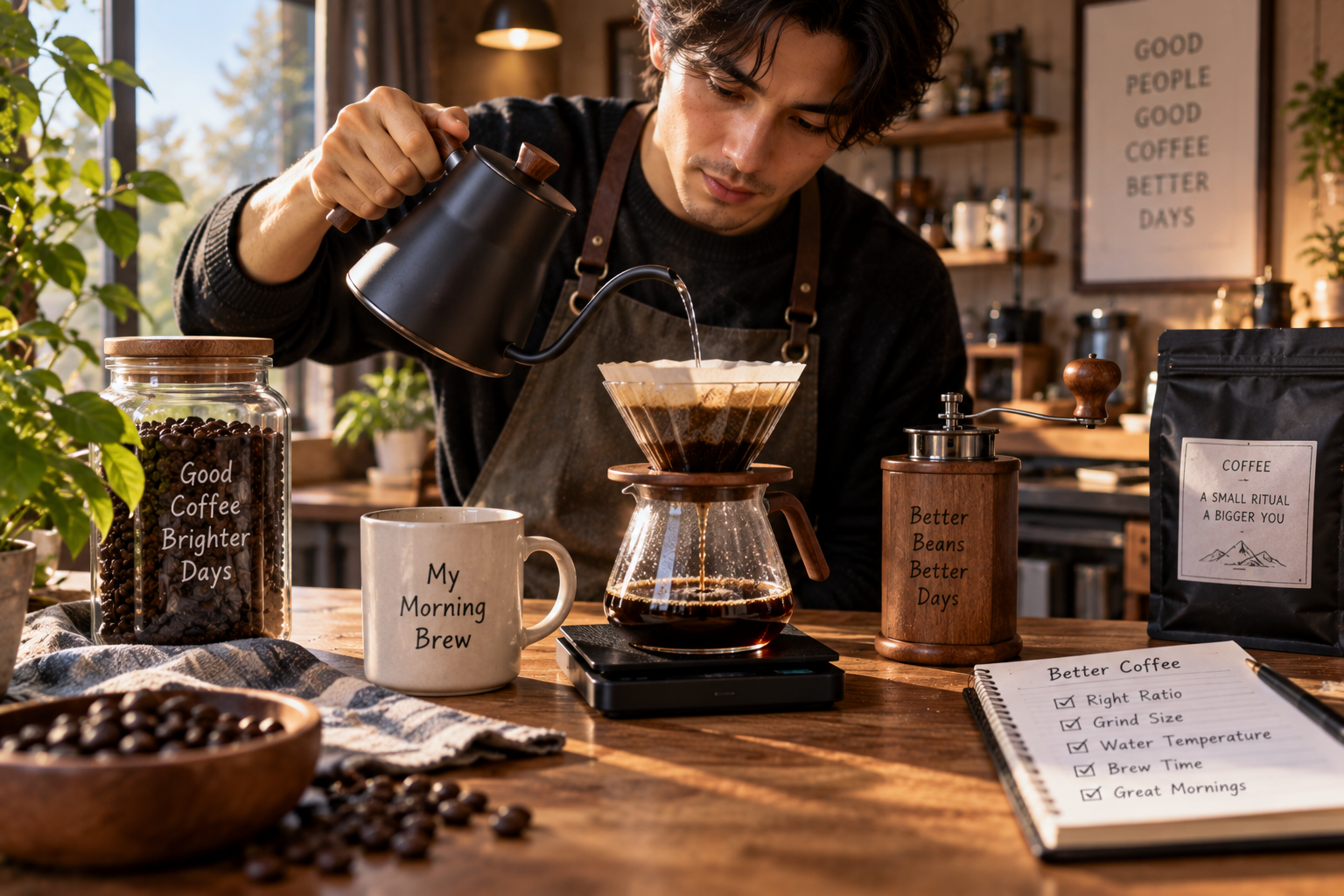
You buy a bag of coffee you genuinely enjoy.
Monday morning, the cup is excellent. It tastes balanced, aromatic, and exactly how you hoped it would.
Tuesday, you use the same beans and the same brewer, but the coffee somehow tastes sharper. Wednesday’s cup feels weak. By Friday, it is noticeably more bitter even though you are convinced you have not changed anything.
It is tempting to blame the beans.
But coffee brewing is a chain of small variables, and “I made it the same way” often means “I made it approximately the same way.”
Learning how to make coffee taste consistent is less about buying increasingly expensive equipment and more about controlling the few variables that have the greatest influence on extraction.
Coffee Brewing Is a Recipe, Even If You Never Treat It Like One
Most people would notice if a cake recipe called for 200 grams of flour and someone casually added somewhere between 150 and 300 grams.
With coffee, we do something similar all the time.
A scoop of beans.
Some water.
A grind setting that looks about right.
Then we expect exactly the same cup every morning.
Coffee is surprisingly sensitive to changes in its recipe. The amount of coffee, water, grind size, temperature, contact time, and pouring method can all affect what ends up in the cup.
Consistency begins when brewing stops being guesswork.
Start by Measuring the Coffee
Scoops are convenient, but they are not particularly precise.
Different coffee beans can have different sizes and densities. One scoop does not necessarily contain exactly the same mass every time.
A small digital scale removes much of that uncertainty.
Instead of remembering that you used “about two scoops,” you know you used 20 grams.
That gives you something repeatable.
If the coffee tastes good, you can reproduce the recipe. If it tastes bad, you have a reliable starting point for adjustment.
Measure the Water Too
Coffee-to-water ratio matters because it determines how concentrated the final beverage becomes.
If you use the same amount of coffee but significantly more water, the cup can taste weaker. Use less water and the result becomes more concentrated.
You do not need to obsess over a universal “perfect ratio.”
Different brewing methods and personal preferences may call for different recipes.
What matters initially is consistency.
Choose a ratio that produces a cup you enjoy, record it, and use it again before changing other variables.
Your Grinder May Be Creating More Variation Than You Realize
Grinding coffee increases the surface area exposed to water.
That makes grind size one of the most influential variables in brewing.
Finer coffee generally exposes more surface area and can increase extraction under otherwise similar conditions. Coarser coffee behaves differently.
But consistency is not only about selecting “fine” or “coarse.”
It is also about producing particles with reasonably consistent sizes.
A grinder that produces a wide mixture of large chunks and very fine particles can make extraction harder to control.
Blade Grinders and Burr Grinders Behave Differently
Blade grinders essentially chop coffee with spinning blades.
The longer they run, the smaller the coffee tends to become, but particle size can be quite uneven.
Burr grinders crush coffee between two surfaces set at a particular distance. This generally provides greater control over grind size.
That does not mean everyone needs an expensive professional grinder.
But if you are trying to understand why your coffee changes dramatically from one brew to another, grind consistency deserves attention.
For many home brewers, improving the grinder can make repeatability easier.
Do Not Change the Grind Setting Randomly Every Morning
You make a cup.
It tastes slightly off.
So you move the grinder several steps.
The next cup tastes different, but now you are not sure whether it improved.
Then you change the coffee dose too.
By the end of the week, every brew uses a different recipe.
This makes troubleshooting almost impossible.
When adjusting coffee, change one major variable at a time.
That way, the result teaches you something.
Brew Time Can Tell You What Is Happening
Depending on the brewing method, contact time between water and coffee can significantly affect extraction.
If a pour-over suddenly drains much faster than usual, something changed.
Perhaps the grind is coarser.
Maybe the pouring technique changed.
The coffee itself could be behaving differently.
If the brew suddenly takes dramatically longer, that is information too.
You do not need to chase an exact second every morning, but timing your brew creates another useful reference point.
Water Temperature Matters
Water needs enough energy to extract soluble compounds from coffee.
If the brewing water changes significantly in temperature from one day to another, the cup can change too.
This commonly happens when people boil water and then wait an unpredictable amount of time before pouring.
One morning they begin almost immediately.
The next morning they answer a message first.
Now the brewing conditions are different.
A temperature-controlled kettle can improve repeatability, but it is not mandatory. Even following the same heating and waiting routine can reduce variation.
Your Pouring Technique Is Part of the Recipe
For manual brewing methods, the person brewing is effectively part of the machine.
How quickly do you pour?
Where does the water land?
How many pours do you make?
How aggressively is the coffee bed disturbed?
If Monday involves a slow controlled pour and Tuesday involves dumping most of the water in quickly because you are late, those are not identical brews.
A simple pouring routine is usually easier to reproduce than an unnecessarily complicated one.
Consistency loves simplicity.
More Agitation Is Not Automatically Better
Stirring, swirling, and pouring all move the coffee grounds.
Some agitation can help water interact with the coffee, depending on the method.
But constantly changing how aggressively you stir or swirl introduces another variable.
If you normally give the brewer one gentle swirl, repeat it.
If you do not stir a particular recipe, do not suddenly add vigorous stirring and then wonder why the cup changed.
Technique becomes useful when it is deliberate rather than random.
Even the Same Coffee Beans Change Over Time
Here is where things become interesting.
You can perform the exact same recipe and still experience some change because the coffee itself is not static.
Roasted coffee gradually changes after roasting.
A newly opened bag may behave somewhat differently after it has been open for days or weeks.
Aroma can change, and the way coffee interacts with brewing water may also shift.
So consistency does not mean the beans will remain chemically identical forever.
It means controlling your process well enough to recognize when the coffee itself is changing.
Storage Matters More Than Fancy Containers
Coffee is sensitive to environmental exposure, particularly oxygen, moisture, heat, and light.
For everyday home use, a practical goal is simply to keep beans in a suitable sealed container in a cool, dry place away from unnecessary heat and sunlight.
You do not necessarily need an elaborate storage system.
What you want to avoid is leaving the bag wide open on a warm counter or repeatedly exposing beans to unfavorable conditions.
Buy quantities you can reasonably use while they still taste good to you.
Freshness management begins with buying habits.
Grinding Immediately Before Brewing Can Improve Repeatability
Whole beans generally preserve their aromatic qualities better than coffee that has already been ground and exposed to air for extended periods.
Grinding immediately before brewing therefore gives you greater control over when that exposure begins.
It also means you can adjust grind size for your brewing method.
Pre-ground coffee can still make an enjoyable cup, especially when convenience matters.
But if your goal is to fine-tune and reproduce a specific flavor, grinding fresh provides another controllable variable.
Your Water Is Most of the Cup
Coffee receives all the attention, but brewed coffee is mostly water.
That makes water quality surprisingly important.
Water with unusual odors or flavors can influence the final drink. Mineral content can also affect extraction and perception.
This is one reason the same coffee can taste different when brewed in another city or house.
You do not necessarily need to turn your kitchen into a water chemistry laboratory.
Start with water that tastes clean and pleasant on its own.
If you dislike drinking the water by itself, it probably will not become invisible when used for coffee.
Filtered Water Can Help in Some Homes
If tap water has a noticeable chlorine-like taste, strong odor, or other characteristics you dislike, filtration may improve the brewing experience.
However, “filtered” does not automatically mean “perfect for coffee.”
Different filtration systems change water in different ways.
The practical point is consistency.
If Monday uses bottled water, Tuesday uses tap water, and Wednesday uses filtered water, you have changed a major ingredient three times.
Use the same water source while evaluating your recipe.
Clean Equipment Makes a Difference
Coffee leaves behind oils and residue.
Over time, these can accumulate on brewers, carafes, filters, grinder components, and other surfaces that contact coffee.
If your cup gradually develops stale or unpleasant flavors even though the recipe has not changed, cleaning deserves attention.
Follow the appropriate cleaning instructions for your equipment.
This is especially important for components that are easy to forget simply because they do not look visibly dirty.
Coffee equipment does not need to look disgusting before residue affects flavor.
Your Mug Can Change the Experience Too
Technically, your brewing recipe may be identical.
But drinking the coffee from a thick ceramic mug versus a thin glass can change how quickly it cools and how the aroma reaches you.
Temperature strongly affects flavor perception.
Coffee that tastes harsh when extremely hot may reveal more detail as it cools.
A cup that seems dull after sitting for an hour is not necessarily evidence that the brewing recipe failed.
When comparing brews, try tasting them under similar conditions.
Stop Judging Coffee Only When It Is Piping Hot
Immediately after brewing, high temperature can make subtle differences difficult to perceive.
Give the coffee a little time.
Taste it hot.
Taste it warm.
Taste it again as it cools.
You may discover that a cup you initially considered disappointing becomes much more enjoyable several minutes later.
This also teaches you what your coffee actually tastes like rather than what heat alone makes you perceive.
Learn the Difference Between Sour and Bitter
These words are often confused.
Someone takes a sip, dislikes it, and says, “It’s bitter.”
But what they actually dislike may be sharp acidity or sourness.
That distinction matters because the adjustments may be different.
In simplified brewing terms, a cup that tastes unpleasantly sour or thin may suggest insufficient extraction, while excessive bitterness, dryness, or harshness can be associated with extracting too much or other brewing issues.
Real coffee flavor is more complicated than a two-word diagnostic chart, but learning to describe what you taste makes adjustments much more useful.
If the Coffee Tastes Too Sour, Adjust Gradually
Suppose your recipe repeatedly produces a sharp, underdeveloped cup.
Do not immediately change five things.
Try one reasonable adjustment.
Depending on the brewing method, that could mean grinding slightly finer, extending contact time, or ensuring the water is sufficiently hot.
Then brew again.
If the cup improves, you learned something.
If it becomes worse, you still learned something because the experiment was controlled.
If the Coffee Tastes Too Bitter, Do the Same Thing in Reverse
An unpleasantly bitter, harsh, or drying cup may suggest that your brewing approach needs adjustment.
Perhaps the grind is too fine for the method.
Maybe contact time is excessive.
Possibly the coffee-to-water relationship does not suit your preference.
Again, avoid making dramatic changes.
Move one variable slightly.
Coffee dialing-in works best as a series of small experiments rather than random reinvention.
Weak Coffee Is Not Always Under-Extracted Coffee
This distinction can be confusing.
Strength and extraction are related but not identical.
A coffee can taste weak because the beverage is too diluted, even if the extraction itself is reasonable.
Similarly, a concentrated coffee can still have extraction problems.
This is another reason measuring coffee and water helps.
When the ratio is known, you can separate “this needs more coffee” from “this coffee is not extracting the way I want.”
Without measurements, both problems simply become “it tastes weird.”
Keep a Tiny Brew Log
This does not need to become homework.
Write down:
- coffee dose,
- water amount,
- grind setting,
- approximate brew time,
- and one sentence about taste.
That is enough for many home brewers.
After several cups, patterns appear.
Maybe the best brews consistently finish around a similar time. Perhaps one grind setting works especially well with a particular bean.
Your memory does not have to carry all of this.
The notes become your reference.
Use the Recipe That Works Until You Have a Reason to Change It
Coffee enthusiasts can easily become trapped in endless optimization.
New recipe.
New technique.
New dripper.
New grinder setting.
New internet trick.
Experimentation is part of the fun, but constant experimentation is the opposite of consistency.
Once you find a recipe that produces coffee you genuinely enjoy, repeat it.
There is no prize for making every morning more complicated than the previous one.
Different Beans May Need Different Adjustments
A recipe that works beautifully for one coffee will not necessarily be ideal for every coffee you buy.
Different origins, varieties, processing methods, roast styles, densities, and ages can influence brewing behavior and flavor.
So consistency does not mean using one permanent grinder setting for the rest of your life.
It means having a stable starting recipe and making deliberate adjustments when the coffee changes.
That is very different from guessing from scratch every morning.
Do Not Chase the Café Cup Exactly
You buy beans from a café because the coffee tasted incredible there.
At home, it tastes different.
That does not necessarily mean you are doing something wrong.
The café may use different water, grinder equipment, brewing hardware, ratios, temperatures, and techniques.
Even if you know the recipe, your equipment may behave differently.
Instead of trying to produce a molecular copy of someone else’s cup, use their recipe as a starting point and adjust for your setup.
The goal is delicious coffee in your kitchen.
Expensive Gear Cannot Fix an Inconsistent Recipe
A premium grinder can improve grind quality.
A precise kettle can control temperature.
A sophisticated brewer may provide additional control.
But equipment cannot decide whether you use 18 grams today and 25 grams tomorrow.
It cannot prevent you from changing five variables simultaneously.
Technique and repeatability still matter.
Before buying another piece of equipment because your coffee is inconsistent, ask whether you actually know the recipe you are currently using.
Sometimes the most useful upgrade is a scale and a notebook.
Your Morning Routine Can Become the Brewing Tool
The easiest way to produce consistent coffee is to make the process familiar.
Use the same equipment.
Keep beans in the same place.
Measure the dose.
Use the same water source.
Follow the same pouring sequence.
Clean the brewer regularly.
Eventually, the process becomes almost automatic.
This is where coffee brewing becomes more than technical optimization.
It becomes part of the rhythm of the morning.
Consistency Does Not Mean Perfection
Some mornings will still produce a better cup than others.
Beans age.
Room conditions change.
Human technique varies.
Equipment behaves imperfectly.
The objective is not to eliminate every microscopic difference.
The goal is to reduce random variation enough that you understand your coffee.
When something changes, you have a better chance of knowing why.
That knowledge makes brewing far less frustrating.
Conclusion
Learning how to make coffee taste consistent begins with controlling the fundamentals rather than searching for one secret brewing trick. Measure your coffee and water, keep grind size reasonably consistent, pay attention to temperature and brew time, use a repeatable technique, and keep your equipment clean.
Then change one variable at a time.
If the cup tastes too sharp, harsh, weak, or simply different from yesterday, resist the urge to rebuild the entire recipe. Make one small adjustment and observe what happens.
Consistency transforms coffee brewing from guesswork into a process you can understand.
And once you understand the process, that excellent cup you accidentally made on Monday morning becomes much easier to make again on Tuesday.